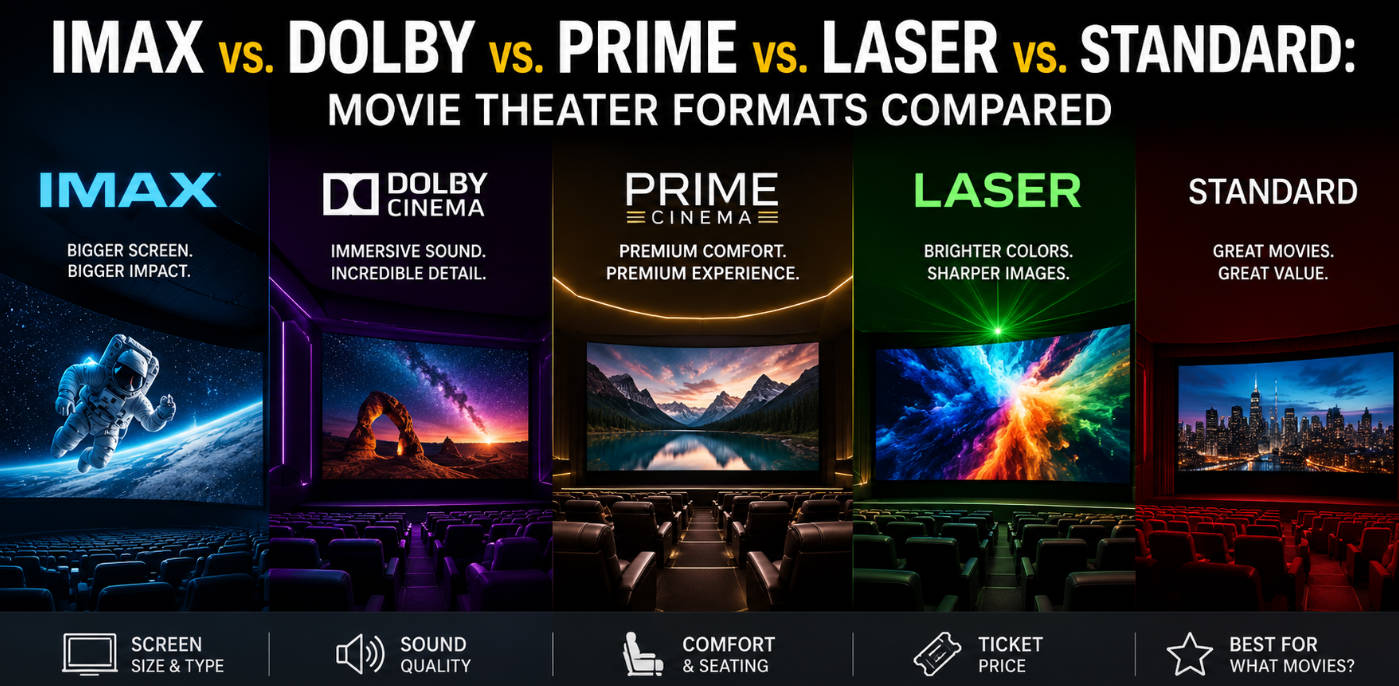
Planning a movie night used to be simple, but hitting the theater today feels like solving a tech puzzle. You’re ready to book tickets for the latest blockbuster, only to be hit with a wall of premium options. Is it worth paying extra for the massive screen of IMAX, or should you opt for the jaw-dropping sound and contrast of Dolby? What exactly do Prime and Laser upgrades bring to the table, and is the standard screen really that inferior? If you’ve ever stared at a seating chart wondering if the premium price tag matches the hype, you’re not alone. In this comprehensive guide, we break down the major cinema formats in 2026, comparing picture quality, audio power, and overall comfort to help you choose the perfect seat for your next big screen experience.
📊Quick Comparison: Movie Theater Formats at a Glance
To save you time at the box office, here is a breakdown of how the major theatrical formats stack up against each other in terms of tech, comfort, and pricing.
|
Feature |
IMAX 70mm |
IMAX with Laser |
Dolby Cinema |
Prime |
Laser (Generic) |
Standard (Digital) |
|---|---|---|---|---|---|---|
|
Resolution |
10K–18K (equivalent) |
4K (4096×2160) |
4K (4096×2160) |
4K |
4K (often 2K in older retrofits) |
2K (usually) |
|
Aspect Ratio |
1.43:1 |
1.43:1 (select) / 1.90:1 |
1.85:1 or 2.39:1 |
1.85:1 |
2.39:1 or 1.85:1 |
2.39:1 or 1.85:1 |
|
Contrast Ratio |
Film-native |
8,000:1 |
1,000,000:1 |
~6,000:1 |
~4,000–5,000:1 |
~2,000:1 |
|
Projection Tech |
Dual 4K Laser |
Dual 4K Laser (Brighter, Aspect Ratio up to 1.43:1 / 1.90:1) |
Dual 4K Laser (Dolby Vision, Best-in-class Contrast) |
Single/Dual 4K Laser or Digital Xenon |
Single 4K Laser (Crisper and more consistent than Xenon) |
Traditional Xenon Bulb / 2K or 4K Digital |
|
3D Brightness |
N/A |
18 FL |
14 FL |
60 fps (3D) |
~12–14 FL |
~6 FL |
|
Audio |
12.1-channel |
12.1-channel |
Dolby Atmos (object-based) |
Dolby Atmos |
5.1 or 7.1-channel |
5.1 or 7.1-channel |
|
Screen Size |
30m+ wide × 23m+ high |
23–32m wide × 17–21m high |
~20m wide × 10m high |
15m+ wide |
Standard size |
Varies (standard) |
|
Picture Quality |
Outstanding brightness and clarity |
Outstanding brightness and clarity |
Dolby Vision HDR with deep blacks |
Bright, sharp images |
Brighter and more consistent than standard digital |
Good overall image quality |
|
Seat Comfort |
Standard Rockers / Selected Recliners |
Standard Rockers / Selected Recliners |
Premium Plush Recliners + Subwoofers |
Power Recliners + Haptic Transducers |
Varies (Standard to Recliner) |
Standard Seating |
|
Typical Price |
$25–$50+ |
$20–$30 |
$18–$30 |
$15–$25 |
$12–$18 |
$10–$15 |
|
Best For |
Ultimate purists |
Epic scale & immersion |
Visual precision & audio |
High-frame-rate action |
Budget-friendly brightness/color upgrade |
Budget-friendly convenience |
🌈Deep Dive: Decoding the Cinematic Formats
IMAX is one of the world's most recognizable premium cinema formats, designed to deliver a larger-than-life movie experience. Compared with standard digital theaters, IMAX combines oversized screens, immersive audio, enhanced projection, and optimized auditorium design to make viewers feel closer to the action. For films shot with IMAX-certified cameras—such as many Hollywood blockbusters—the experience can be dramatically more immersive.
💎The Three IMAX Tiers: What You're Actually Getting
⏩IMAX 70mm (Film) – The Holy Grail
The original and best. Only about 19 screens in the U.S. can show this format. Uses 15-perforation 70mm film running horizontally through the projector, creating an image area 9× larger than 35mm film. Tickets sell out fast—resale prices for major releases can hit $500–$1,000.
⏩IMAX with Laser – The Modern Standard
The digital evolution. Uses dual 4K laser projectors with 50% greater brightness than standard digital cinema. Supports 1.43:1 in IMAX GT locations with proper screens. Features the full 12-channel sound system.
⏩IMAX Digital (2K Xenon) – The Compromise
Older technology using xenon lamps. Runs at just 2K resolution with a 1.90:1 aspect ratio. Many multiplex "IMAX" theaters are actually this format—critics say the aspect ratios are off, sound quality is inferior, and resolution falls short of true IMAX
✅IMAX Format: Key Features at a Glance
| Feature | IMAX 70mm (Film) | IMAX with Laser (Digital) | IMAX Digital (2K Xenon) |
|---|---|---|---|
| Resolution | ~10K–18K equivalent | 4K (dual 4K projectors) | 2K |
| Aspect Ratio | 1.43:1 | 1.43:1 (select GT locations) or 1.90:1 | 1.90:1 |
| Projection | 15/70mm film, horizontal | Dual laser (xenon-free) | Dual xenon lamp |
| Brightness | Film-native | 50% greater than DCI spec | ~2,500:1 contrast ratio |
| Contrast | Film-native | Double IMAX 70mm contrast | 2,500:1 |
| Color Gamut | Film-native | Rec. 2020 (full) | DCI-P3 |
| Audio | 12.1-channel (select) | 12-channel + sub-bass | 5.1 or 6-channel |
| Screen Size | 18m+ tall × 24m+ wide | 17–21m tall × 23–32m wide | Variable (retrofitted) |
| Availability | ~19 screens in U.S. | Widely available | Most common |
| Typical Price | $25–$50+ | $20–$26 | $18–$25 |
🎬Visuals & Picture Quality
IMAX is built around one core philosophy: maximum image. The format delivers this through:
| Core Attribute | IMAX Advantage |
|---|---|
| More Picture | 1.43:1 ratio shows 26%–40% more image than standard widescreen (2.39:1). |
| Resolution | 70mm hits ~18K equivalent; Laser delivers dual 4K for seamless clarity. |
| HDR & Color | Laser supports full Rec. 2020 gamut with contrast double that of film. |
| 3D Performance | Laser delivers 18 FL brightness—much brighter than standard ~6 FL. |
🔉Audio System (12-Channel Layout)
IMAX's 12-channel sound system is a significant upgrade from standard cinema audio:
| Speaker Placement | Channels |
|---|---|
| Behind the Screen | 3 Full-range |
| Side Walls (L/R) | 2 Each Side |
| Rear Corners | 2 |
| Overhead (Ceiling) | 4 |
| Subwoofer | Dedicated (1 octave lower bass than standard) |
Key takeaway: Overhead speakers and deeper bass create precise, object-like immersion—sounds fly over your head, not just side-to-side.
💺Seating & Theater Design
| Aspect | Details |
|---|---|
| Stadium Layout | Steep risers ensure every seat faces the screen "face-first"—zero obstructions. |
| Comfort Level | Standard plush seats; not luxury power-recliners (unlike Dolby/Prime). |
| Sweet Spot | Sit one-third to half the distance from the screen. Avoid the first 5 rows to save your neck. |
Recommended seating: Sit one-third to half the distance from the screen for the best immersion. Avoid the first 5 rows to prevent neck strain
🆚Pros and Cons
| ✅ Pros | ❌ Cons |
|---|---|
| Unmatched peripheral-filling scale. | Pricey—$5–$8+ more than standard tickets. |
| Up to 40% more visible image area. | Inconsistent quality—2K Xenon "IMAX" is a shadow of Laser/70mm. |
| Best-in-class 3D brightness (18 FL). | Standard seating—no luxury recliners. |
| Director-preferred format for blockbusters (Nolan, Villeneuve). | Overkill for dramas or romantic comedies. |
| Powerful 12.1-channel overhead audio. | 70mm availability is extremely rare (~19 screens). |
💰 Typical Ticket Pricing
| Format | Price Range |
|---|---|
| Standard Digital | $10–$15 |
| IMAX Digital (2K) | $18–$25 |
| IMAX with Laser | $20–$26 |
| IMAX 70mm | $25–$50+ |
Prices surge for major releases. Dune: Part Three IMAX 70mm tickets hit $50**, and *The Odyssey* resale tickets reached **$500–$1,500 on secondary markets.
🎯Who Is IMAX Best For?
| Choose IMAX If... | Skip IMAX If... |
|---|---|
| Watching sci-fi, action, or superhero blockbusters. | Watching drama, rom-com, or indie films. |
| The film is "Shot with IMAX" or "Filmed for IMAX". | You prioritize luxury recliners over screen size. |
| You want to feel swallowed by the screen. | You are on a strict budget. |
| Watching 3D content. | The only local option is the old 2K Xenon version. |
📌Final Verdict (One Sentence)
IMAX is the undisputed king of spectacle and scale—but only choose IMAX with Laser or 70mm to get the real deal; skip the older 2K xenon "IMAX" if you care about quality, and save it for movies that actually fill that giant screen.
Developed by Dolby Laboratories, Dolby Cinema is a premium movie theater format that combines Dolby Vision projection with Dolby Atmos immersive audio. While IMAX focuses on delivering the biggest screen possible, Dolby Cinema emphasizes superior picture quality, lifelike colors, deep blacks, and immersive surround sound. It's widely regarded as one of the best formats for viewers who prioritize image fidelity and cinematic audio over screen size.
✅Dolby Format: Key Features at a Glance
| Feature | Dolby Cinema |
|---|---|
| Resolution | 4K (4096 × 2160) Dual Laser |
| Aspect Ratio | 1.85:1 or 2.39:1 (Standard widescreen – no expanded IMAX ratio) |
| Projection Tech | Dual 4K Laser (Christie) |
| Vision Tech | Dolby Vision (Dynamic HDR) |
| Contrast Ratio | 1,000,000:1 (125× better than IMAX Laser) |
| Peak Brightness (2D) | 31 FL (vs. ~14 FL standard) |
| Peak Brightness (3D) | 14 FL (with glasses – no dimming) |
| Color Depth | 12‑bit (vs. 10‑bit IMAX) – smoother gradients |
| Color Gamut | Rec. 2020 (Full) |
| Audio Tech | Dolby Atmos (Object‑based, 3D spatial) |
| Audio Channels | Up to 128 independent sound objects + 64 speaker outputs |
| Seating | Full leather power recliners (with bass shakers) |
| Screen Size | ~20m wide × 10m high (modest vs. IMAX) |
| Availability | ~300+ locations globally (growing) |
| Typical Price | $18 – $30 |
⚠️ Critical Warning: Look for the "DOLBY CINEMA" badge. Many theaters advertise "Dolby Atmos" (sound only) but lack the Dolby Vision laser projection. Only the full Dolby Cinema package gives you the specs below.
🎬Visuals & Picture Quality
| Core Attribute | Dolby Cinema Advantage |
|---|---|
| Contrast King | 1,000,000:1 – pure, inky blacks (pixels turn off completely). Night scenes reveal details invisible in other formats. |
| Dynamic HDR | Dolby Vision adjusts brightness/color frame‑by‑frame (not scene‑by‑scene) for perfect optimization. |
| Brightness | 31 FL for 2D – twice as bright as standard. 3D stays bright (14 FL) because the laser compensates for glasses. |
| 12‑Bit Color | 68 billion colors vs. 1 billion (10‑bit). No banding in skies or gradients – buttery smooth. |
| Screen Size Trade‑off | Smaller than IMAX – you trade scale for pixel‑perfect clarity. |
🔉Audio System (Dolby Atmos)
| Feature | How It Works |
|---|---|
| Object‑Based | Sounds are placed in 3D space (X, Y, Z coordinates) – not locked to specific channels. |
| Overhead Effects | Ceiling speakers make rain, helicopters, and footsteps move above and around you. |
| Speaker Outputs | Up to 64 discrete speakers, plus subwoofers – but the object count can reach 128. |
| Seat Integration | Bass shakers vibrate with low frequencies – you feel the explosion in your chest. |
"In Dolby Atmos, a bullet doesn't go left‑to‑right – it flies from front‑left, over your head, and lands behind your right ear."
💺Seating & Theater Design
| Aspect | Details |
|---|---|
| Seat Type | Full leather power recliners – wide, plush, with adjustable headrests. |
| Haptic Feedback | Transducers in the seats vibrate with the audio bass (adds physical immersion). |
| Theater Layout | Stadium seating with good sightlines, but screen is lower and smaller than IMAX. |
| Ambient Lighting | Blue LED aisle lighting dims during previews and goes completely dark during the film – no light bleed on the screen. |
🆚 Pros & Cons (At a Glance)
| ✅ Pros | ❌ Cons |
|---|---|
| Best image quality of any mainstream format – pure blacks, blinding highlights. | Screen is smaller than IMAX – no towering, floor‑to‑ceiling immersion. |
| Best audio – object‑based Atmos is unmatched for spatial realism. | No expanded aspect ratio – you see the standard widescreen crop, not the extra 26‑40% image. |
| Luxury seating – full leather recliners with bass shakers (superior to IMAX's standard seats). | Premium price – often same or higher than IMAX Laser ($18‑$30). |
| Consistent quality – every Dolby Cinema meets strict technical standards (unlike "IMAX" which varies wildly). | Not ideal for massive spectacle films that need a giant canvas (e.g., Dune). |
| Superior 3D – no brightness loss thanks to the laser. | Limited to ~300 locations globally – not as common as standard theaters. |
💰Price Breakdown (2026)
| Format | Price Range | Note |
|---|---|---|
| Standard Digital | $10 – $15 | Baseline. |
| Generic Laser | $12 – $18 | Better brightness, no premium audio/seats. |
| IMAX with Laser | $20 – $26 | Scale and extra image. |
| Dolby Cinema | $18 – $30 | Priced neck‑and‑neck with IMAX Laser. |
| IMAX 70mm | $25 – $50+ | For scale purists. |
🎯Who Is Dolby Cinema Best For?
| Choose Dolby Cinema If... | Skip Dolby Cinema If... |
|---|---|
| You prioritize image perfection (contrast, color, HDR) over screen size. | You want to feel swallowed by a massive floor‑to‑ceiling canvas. |
| Watching films with stunning cinematography (Blade Runner 2049, The Batman, Oppenheimer). | The film was "Shot with IMAX" – you'd miss the extra picture. |
| You are an audiophile – Atmos delivers pin‑point 3D audio unmatched by channel‑based systems. | You're on a strict budget – standard digital is fine for comedies/dramas. |
| You value seat comfort – those leather recliners make 3‑hour epics easy. | You're seeing a pure visual spectacle where size matters most (e.g., Avatar). |
| You hate inconsistent quality – Dolby Cinema guarantees the same premium experience everywhere. | Your local theater only offers "Dolby Atmos" (sound) without "Dolby Cinema" (Vision + Laser). |
📌Final Verdict (One Sentence)
Dolby Cinema is the king of fidelity – offering the sharpest picture, the most immersive sound, and the comfiest seats, but if you crave sheer scale and extra picture, IMAX still wears the crown for spectacle.
AMC Prime (often referred to simply as Prime) is a specialized premium format exclusive to AMC Theatres. It was originally designed to bridge the massive gap between standard auditoriums and ultra-premium setups like Dolby Cinema. Think of Prime as a "greatest hits" compilation—it borrows high-end comfort and sound features from luxury formats but strips away the proprietary, expensive visual technology to keep ticket prices reasonable.
There are two distinct versions:
| AMC Prime (U.S.) | Wanda Prime (China) | |
|---|---|---|
| Status | Largely phased out or converted to Dolby Cinema | Active and expanding |
| Core Tech | 4K Laser + Dolby Atmos + Recliners | RealD Ultimate Screen + Christie 4K Laser + Dolby Atmos + HFR |
| Differentiator | Premium seating with rumble | 120 fps High Frame Rate |
⚠️ Critical Warning: Many AMC "Prime" locations have been converted to Dolby Cinema. If you see "Prime" at an AMC today, confirm what's actually installed—it may be a legacy label rather than the full premium package
✅AMC Prime Format: Key Features at a Glance
| Feature | AMC Prime | Wanda Prime |
|---|---|---|
| Resolution | 4K Laser (Barco/Cinionic) | 4K Stereoscopic 3D |
| Projection Tech | Laser | Christie 4K Laser |
| Screen Tech | Standard PLF screen | RealD Ultimate Screen (92% reflectivity) |
| Aspect Ratio | 1.85:1 or 2.39:1 | 1.85:1 or 2.39:1 |
| High Frame Rate | Not standard | 120 fps (2D) / 60 fps (3D) |
| Contrast Ratio | ~6,000:1 | ~6,000:1 |
| Audio | Dolby Atmos | Dolby Atmos |
| Audio Channels | Object-based (up to 128 objects) | Object-based (up to 128 objects) |
| Seating | Power recliners + bass transducers | Custom luxury recliners |
| Screen Size | 15m+ wide | 15m+ wide |
| Availability | Limited (mostly converted) | Growing in China |
| Typical Price | $15 – $25 | ¥80 – ¥150 (~$11–$21) |
🎬Visuals & Picture Quality
| Core Attribute | Prime Advantage |
|---|---|
| 4K Laser Clarity | Both versions use 4K laser projection—sharper and brighter than standard xenon. |
| High Frame Rate (Wanda) | 120 fps eliminates motion blur in action scenes—crystal-clear car chases, fights, and sports. |
| RealD Ultimate Screen (Wanda) | 92% reflectivity vs. ~50% for standard screens—significantly brighter image. |
| No Expanded Ratio | Unlike IMAX, Prime uses standard widescreen ratios—no extra picture. |
"The system offers film screenings in 4K stereoscopic 3D at 120 frames per second, which is considered superior compared to the often-used 24 frames per second."
🔉Audio System (Dolby Atmos)
Both AMC and Wanda Prime feature Dolby Atmos—the same object-based audio found in Dolby Cinema.
| Feature | How It Works |
|---|---|
| Object-Based | Sounds are placed in 3D space (X, Y, Z) — not locked to channels. |
| Overhead Effects | Ceiling speakers make rain, helicopters, and footsteps move above and around you. |
| Sound Objects | Up to 128 individual sounds can be placed and moved independently. |
| Bass Transducers | Seats rumble with low frequencies—you feel explosions. |
⚠️ Important: Prime has Atmos audio, but—unlike Dolby Cinema—it does not include Dolby Vision HDR.
💺Seating & Theater Design
| Aspect | Details |
|---|---|
| Seat Type | Power recliners with wide, plush cushioning. |
| Haptic Feedback | Transducers in the seats vibrate with the soundtrack—bass you can feel. |
| Comfort Level | Superior to IMAX (standard seats) — comparable to Dolby Cinema. |
| Custom Configuration (Wanda) | Fully customized theater layout for optimal viewing. |
🆚Pros & Cons
| ✅ Pros | ❌ Cons |
|---|---|
| Luxury seating — power recliners with bass rumble (better than IMAX). | No Dolby Vision — lacks the 1,000,000:1 contrast of Dolby Cinema. |
| Dolby Atmos audio — immersive 3D sound on par with Dolby Cinema. | No expanded aspect ratio — you don't get IMAX's extra picture. |
| 4K Laser projection — crisp, bright image. | Inconsistent quality — "Prime" varies wildly by location. |
| High Frame Rate (Wanda) — 120 fps eliminates motion blur in action. | AMC Prime is fading — many locations converted to Dolby Cinema. |
| Comfort-first — better seats than IMAX, period. | Not a global standard — what you get depends on the chain. |
💰Price Breakdown (2026)
| Format | Price Range | Note |
|---|---|---|
| Standard Digital | $10 – $15 | Baseline. |
| Generic Laser | $12 – $18 | Better brightness, no premium extras. |
| AMC Prime | $15 – $25 | Premium seating + Atmos + Laser. |
| Wanda Prime | ¥80 – ¥150 (~$11–$21) | Varies by city and showtime. |
| IMAX with Laser | $20 – $26 | Scale and extra image. |
| Dolby Cinema | $18 – $30 | Superior contrast + Vision HDR. |
AMC Prime was originally priced $4–$6 more than standard tickets—roughly $15–$25 in 2026 dollars.
🎯Who Is Prime Best For?
| Choose Prime If... | Skip Prime If... |
|---|---|
| You prioritize seat comfort over everything—recliners with bass rumble beat IMAX's standard seats. | You want the absolute best picture quality — Dolby Cinema's contrast is 125× better. |
| You're watching action, sports, or 3D (Wanda's 120 fps eliminates motion blur). | The film was "Shot with IMAX" — you'd miss the expanded picture. |
| You want Dolby Atmos audio without paying Dolby Cinema prices. | You're at an AMC — many "Prime" locations are legacy labels with inconsistent quality. |
| You value comfort + sound over screen size. | You want a guaranteed premium experience — Dolby Cinema and IMAX Laser are more consistent. |
| You're in China at a Wanda Prime location — the 120 fps experience is genuinely unique. | You're a picture purist — Prime lacks Dolby Vision HDR. |
📌Final Verdict (One Sentence)
Prime is the comfort king—offering luxury recliners, rumbling seats, and Dolby Atmos at a mid-tier price—but it's not a unified standard, so check what's actually installed at your local theater, and if you're after the best picture quality, Dolby Cinema still wins.
Unlike IMAX, Dolby Cinema, or PRIME, Laser Cinema is not a single branded premium format. Instead, it refers to movie theaters that use laser projection technology instead of traditional xenon digital projectors. Many cinema chains—including AMC, Regal, Cinemark, Vue, Cineworld, CGV, and others—offer laser-equipped auditoriums. Laser projection delivers brighter images, improved contrast, richer colors, and longer-lasting performance, making it one of the biggest upgrades over Standard (Digital) cinema.
✅Laser Cinema Format: Key Features at a Glance
| Feature | Laser Projection | Standard Digital (Xenon Lamp) |
|---|---|---|
| Light Source | Laser diodes (solid-state) | Xenon arc lamp |
| Resolution | 2K or 4K (DCI standard) | 2K (mostly) |
| Peak Brightness | 20–60 fL (up to 4× brighter) | 14–30 fL (degrades over time) |
| Color Gamut | Up to 100% DCI P3 + beyond Rec.2020 | ~85% DCI P3 |
| Contrast Ratio | Up to 10,000:1 native | ~2,000:1 |
| HDR Capability | Full HDR10 / Dolby Vision compatible | Limited |
| Brightness Consistency | Stable over 20,000+ hours | Degrades as lamp ages |
| Lamp/Light Source Life | 20,000–30,000 hours | 1,500–3,000 hours |
| Maintenance | Low (no lamp replacements) | High (frequent bulb changes) |
| Energy Consumption | Lower | Higher (runs hot, more HVAC) |
| Aspect Ratio | 1.85:1 or 2.39:1 | 1.85:1 or 2.39:1 |
| Screen Size | Standard theater size | Standard theater size |
| Audio | 5.1 or 7.1 (usually) | 5.1 or 7.1 |
| Seating | Standard (varies by theater) | Standard |
| Typical Price | $12 – $18 | $10 – $15 |
🎬Visuals & Picture Quality
| Core Attribute | Laser Advantage |
|---|---|
| Brighter Image | Peak brightness can reach 20–60 fL—up to 4× brighter than xenon. The image stays consistently bright, even on very large screens. |
| Better Colors | Laser produces more accurate and vibrant colors. RGB laser systems can achieve up to 100% of the DCI P3 color gamut—the cinema industry standard. |
| Deeper Contrast | Native contrast ratios up to 10,000:1 vs. xenon's ~2,000:1. Dark scenes reveal details that get lost in standard projection. |
| Consistent Quality | Xenon lamps dim and lose color accuracy as they age. Laser maintains consistent brightness and color over its entire 20,000+ hour lifespan. |
| No Color Drift | Laser doesn't suffer from the color drift that plagues aging xenon systems. |
Two Types of Laser Projection: Not all laser is created equal. There are two main configurations:
| Type | How It Works | Quality |
|---|---|---|
| Phosphor Laser | Blue laser array excites a yellow phosphor wheel to produce white light | Good—brighter than xenon, but color accuracy is limited |
| RGB Laser | Dedicated red, green, and blue laser arrays create color directly | Excellent—the most advanced, with full color gamut and no phosphor conversion loss |
⚠️ What you won't see: Unlike IMAX, laser projection does not offer an expanded aspect ratio (1.43:1 or 1.90:1). You get standard widescreen (1.85:1 or 2.39:1). No extra picture.
🔉Audio System
Here's the key catch with generic laser: audio is not part of the laser standard.
| Aspect | Laser (Generic) |
|---|---|
| Audio Format | Usually 5.1 or 7.1-channel surround—same as standard digital |
| Immersive Audio? | No—unless the theater also installs Dolby Atmos or another premium sound system |
| Overhead Speakers? | Not typically—those are reserved for premium formats |
The laser upgrade is visual only. If you want the immersive 3D audio of Dolby Atmos, you need Dolby Cinema or a Prime theater—not just any laser-equipped auditorium.
💺Seating & Theater Design
| Aspect | Details |
|---|---|
| Seat Type | Standard theater seats—unless the theater has separately upgraded to recliners |
| Comfort Level | Varies by location—laser alone doesn't guarantee premium seating |
| Theater Design | Standard layout—no proprietary IMAX-style stadium seating or Dolby's blue-aisle lighting |
Some theaters do combine laser projection with upgraded seating—like AMC's "laser auditoriums" with power recliners—but this is a separate investment, not part of the laser standard.
🆚Pros & Cons
| ✅ Pros | ❌ Cons |
|---|---|
| Brighter, sharper image—noticeably better than standard xenon. | No proprietary ecosystem—laser alone doesn't guarantee premium audio or seating. |
| More vibrant colors—richer and more lifelike, especially in animated and sci-fi films. | No expanded aspect ratio—you don't get IMAX's extra picture. |
| Deeper blacks—dark scenes have more detail. | Inconsistent experience—quality depends on the specific theater's screen, audio, and seating. |
| Consistent quality—no dimming or color drift over time. | Higher ticket prices—typically $2–$5 more than standard digital. |
| Longer lifespan—20,000–30,000 hours vs. 1,500–3,000 for xenon lamps. | Laser speckle—some viewers notice a slight shimmering effect on flat backgrounds. |
| Lower operating costs—no lamp replacements and lower energy consumption. | Screen dependency—an older screen may not reflect laser light optimally, reducing the benefit. |
💰Price Breakdown (2026)
| Format | Price Range | Note |
|---|---|---|
| Standard Digital | $10 – $15 | Baseline—xenon lamp projection. |
| Laser (Generic) | $12 – $18 | Usually ~$2–$3 more than standard. |
| AMC Prime | $15 – $25 | Laser + Atmos + recliners. |
| IMAX with Laser | $20 – $26 | Laser + IMAX scale + 12-channel audio. |
| Dolby Cinema | $18 – $30 | Laser + Dolby Vision + Atmos + recliners. |
| IMAX 70mm | $25 – $50+ | Film-based, not laser. |
In 2026, a premium laser screening at AMC averages around $18 per ticket, though prices vary by market and showtime.
🎯Who Is Laser Best For?
| Choose Laser If... | Skip Laser If... |
|---|---|
| You want better image quality than standard digital without paying IMAX/Dolby prices. | You want the absolute best—Dolby Cinema's 1,000,000:1 contrast is 100× better. |
| You're watching a visually rich film—action, sci-fi, animation, or big-budget blockbusters. | You want immersive 3D audio—laser alone doesn't give you Atmos. |
| You're on a moderate budget—laser is a cost-effective upgrade over standard. | You want expanded picture—only IMAX gives you more image area. |
| Your local theater has upgraded to 4K laser with a good screen. | You're watching a dialogue-driven drama or comedy—the difference is less noticeable. |
| You value consistent quality—no worrying about a dim, aging bulb. | The theater's laser is phosphor-based (not RGB)—the upgrade is more modest. |
📌Final Verdict (One Sentence)
Laser projection is the biggest performance leap in commercial cinema since the transition from film to digital. It delivers brighter, sharper, more colorful images that stay consistent over time, with lower maintenance costs for theaters
When you look at a movie theater's booking app and see a listing labeled simply as Standard (or sometimes Digital / 2D), you are looking at the classic, foundational movie theater experience.
For the past two decades, this format has been powered by traditional Xenon bulb digital projectors. While the industry is steadily phasing this format out in favor of Laser, Standard Digital remains the most widely available and accessible option in the world.
✅Standard Digital Format: Key Features at a Glance
| Feature | Standard Digital (Xenon-based) |
|---|---|
| Resolution | 2K (2048 × 1080) — some newer installs have 4K, but 2K is the industry workhorse |
| Aspect Ratio | 2.39:1 (Scope) or 1.85:1 (Flat) — no expanded IMAX ratio |
| Projection Tech | Xenon arc lamp (dual or single) |
| Peak Brightness (2D) | ~14 FL (degrades to ~10 FL as lamp ages) |
| Peak Brightness (3D) | ~6 FL (often dark and murky) |
| Contrast Ratio | ~2,000:1 (limited by xenon's native capability) |
| Color Gamut | ~85% DCI P3 (some lamps drift over time) |
| Audio Format | 5.1 or 7.1-channel surround sound |
| Overhead Speakers? | No — standard surround is horizontal only |
| Screen Size | Standard multiplex size (varies widely) |
| Seating | Standard stadium seats (non-recliner, basic cushioning) |
| Bass Transducers? | No |
| Availability | The vast majority of screens (~90%+ of theaters) |
| Typical Price | $10 – $15 |
🎬Visuals & Picture Quality
| Core Attribute | What You Get |
|---|---|
| Resolution | 2K (2048 × 1080) is the workhorse. Fine for most content, but 4K is sharper—textures like sand, skin, and fabric lose fine detail at 2K. |
| Brightness | ~14 FL for 2D on a new bulb. But bulbs dim quickly—after 1,500 hours, you're often watching 10 FL or less. For 3D, the glasses cut brightness to just 4–6 FL, which is notoriously dim. |
| Contrast | ~2,000:1 is the best-case native contrast. Dark scenes often look gray and muddy rather than deep black. Details in shadows get crushed or lost. |
| Color Accuracy | Lamps start with decent color, but color drift occurs as the bulb ages. You might see a green or yellow tint in older projectors. |
| No Expired Ratio | You get the standard theatrical crop. If a film was shot for IMAX's 1.43:1 or 1.90:1, you'll see a cropped version—up to 40% less image. |
🔈Audio System
| Aspect | Details |
|---|---|
| Audio Format | 5.1-channel or 7.1-channel surround sound |
| Speaker Layout | Left, Center, Right, Left Surround, Right Surround, Subwoofer (+ 2 rear speakers for 7.1) |
| Overhead Effects | None — sound is locked to horizontal channels around the room. No flying bullets overhead. |
| Sound Precision | Channel-based, not object-based. A sound comes from speaker A or speaker B, rather than moving dynamically through 3D space. |
| Bass Impact | Standard subwoofer is fine, but lacks the chest-punching low-end depth of IMAX's 12-channel system or Dolby's Atmos. |
"Standard 5.1 is like stereo from the 90s—it works, but you're not inside the sound. Sounds move left-to-right, not over-and-through."
💺Seating & Theater Design
| Aspect | Details |
|---|---|
| Seat Type | Standard stadium seating — padded but basic fabric, fixed-back (manual recline if any). |
| Legroom | Typically 40–45 inches between rows—adequate but can feel cramped for tall moviegoers. |
| Power Recliners? | No — unless the chain has made a separate, chain-wide upgrade to "recliner auditoriums" (e.g., some AMC/Regal locations). But that's a theater upgrade, not part of the digital standard. |
| Theater Layout | Standard stadium risers, but no proprietary floor-to-ceiling immersive design (unlike IMAX's "box"). |
| Ambient Light | Often some light bleed from exit signs or aisle lighting—this reduces the perceived contrast on screen. |
🆚Pros & Cons
| ✅ Pros | ❌ Cons |
|---|---|
| Most affordable — cheapest tickets in the theater ($10–$15). | Low contrast (~2,000:1) — dark scenes look gray, not black. |
| Widely available — every multiplex has multiple standard screens. | Dim 3D — at ~6 FL, 3D feels like watching through sunglasses. |
| No decision fatigue — just buy a ticket and go. | 2K resolution — loses fine detail compared to 4K. |
| Good enough for dialogue-driven films (dramas, comedies, rom-coms). | Aging bulbs — brightness and color degrade significantly over time. |
| Consistent showtimes — standard screens run all day, every day. | No immersive audio — 5.1/7.1 lacks overhead effects. |
| No premium upcharge — great for families or frequent moviegoers. | No expanded aspect ratio — you miss up to 40% of the image if the film was shot for IMAX. |
| Varies widely — quality depends on the theater's maintenance schedule and bulb replacement practices. |
💰 Price Breakdown (2026)
| Format | Price Range | Note |
|---|---|---|
| Standard Digital | $10 – $15 | *US average ticket is ~$10.50* — though metro areas hit $15+. |
| Generic Laser | $12 – $18 | ~$2–$3 more for the visual upgrade. |
| AMC Prime | $15 – $25 | Laser + Atmos + recliners. |
| IMAX with Laser | $20 – $26 | Scale + extra image + 12-channel audio. |
| Dolby Cinema | $18 – $30 | Premium contrast + Dolby Vision + Atmos + recliners. |
| IMAX 70mm | $25 – $50+ | Film-based rarity. |
Matinee shows, discount Tuesdays, and loyalty memberships can drop standard tickets to $6–$8 in many chains. No premium format touches that price point.
🎯Who Is Standard Digital Best For?
| Choose Standard Digital If... | Skip Standard Digital If... |
|---|---|
| You're on a strict budget or going to the movies frequently. | You're watching a visually stunning blockbuster (Dune, Avatar, Oppenheimer). |
| You're watching a dialogue-driven film — dramas, romantic comedies, thrillers, or indie films. | The film was "Shot with IMAX" or "Filmed for IMAX" — you'd miss the expanded picture. |
| You're taking a family with kids who won't care about picture quality. | You want immersive 3D — standard 3D is too dim. |
| You're a casual viewer who just wants to see the movie without overthinking specs. | You're a cinephile who notices color banding, contrast ratios, and resolution differences. |
| You're going to a matinee or discount day to maximize value. | You value premium seat comfort — standard seats are basic compared to Dolby/Prime recliners. |
| The movie doesn't rely on visual effects, color, or sound design to tell the story. | You want object-based audio (Atmos) or overhead effects. |
📌Final Verdict (One Sentence)
Standard Digital is the Honda Civic of cinema. It's reliable, affordable, and gets you from point A to point B without fuss. But it won't give you the thrill of a sports car (IMAX), the luxury of a Mercedes (Dolby), or the smoothness of an EV (Laser).
📜How to Choose the Right Movie Theater Format: A Practical Guide
You’ve just spent $25 on an IMAX ticket, but the screen was dim, the seats were cramped, and the movie didn’t even fill the whole frame. Sound familiar?
Here’s the hard truth: Movie theaters are terrible at explaining what you’re actually paying for. They slap labels like "IMAX," "Laser," and "Dolby Atmos" on tickets without telling you if you're getting the real premium experience or a watered-down impostor.
This guide cuts through the marketing fluff. Use it to:
✅ Never overpay for a format that doesn't match the movie
✅ Spot fake "premium" screens instantly
✅ Pick the perfect seat for every format
✅ Save up to 50% on tickets without sacrificing quality
Step 1: The 3-Question Pre-Ticket Checklist
Before you even open the ticketing app, ask yourself these three questions. Your answers will filter out 80% of the wrong choices.
| Question | Why It Matters |
|---|---|
| 1. Was the film shot with IMAX cameras? | If YES, you MUST choose IMAX (Laser or 70mm) to see the extra 26–40% picture. If NO, IMAX loses its biggest advantage. |
| 2. Is this a visual spectacle or a dialogue drama? | Dune, Avatar, Top Gun → premium required. A rom-com or drama → standard is fine. |
| 3. What's your priority: Scale, Picture Quality, Audio, or Comfort? | Scale = IMAX. PQ = Dolby Cinema. Audio = Dolby Cinema/Atmos. Comfort = Prime/Dolby. |
💡 The Golden Rule: Only pay premium prices for movies that actually demand premium technology.
Step 2: Decision Matrix – Choose by Movie Type
| Movie Type | Best Format | 2nd Best | Why |
|---|---|---|---|
| Sci-Fi / Action / Superhero (Dune, Avengers) | IMAX with Laser | Dolby Cinema | Scale + extra picture makes you feel inside the world. |
| Cinematography-Driven (Blade Runner, The Batman) | Dolby Cinema | IMAX with Laser | The 1,000,000:1 contrast reveals details in dark scenes that IMAX crushes. |
| High-Octane Action / Sports (Fast & Furious, F1) | Prime (Wanda) or Dolby Cinema | IMAX with Laser | High frame rate (Prime) eliminates motion blur; Dolby Atmos makes you feel the speed. |
| 3D Movies (Avatar, animated films) | IMAX with Laser | Dolby Cinema | Laser IMAX delivers 18 FL brightness; standard 3D is a dim mess (~6 FL). |
| Animated / Colorful (Spider-Verse, Pixar) | Dolby Cinema | Laser (generic) | 12-bit color and Rec.2020 gamut make animation pop like nowhere else. |
| Drama / Rom-Com / Indie | Standard Digital | Laser (generic) | No spectacle = no need to splurge. Save your money. |
| Christopher Nolan Film | IMAX 70mm (if available) | IMAX with Laser | Nolan films are built for IMAX—you'll miss a massive chunk of the frame otherwise. |
Step 3: Format Cheat Sheet – The "Read Before You Buy" Decoder
Here's the critical trap: The same format name can mean wildly different things. Memorize this decoder before you click "purchase."
| What the Ticket Says | What You're Actually Getting | ✅ Go / ❌ No-Go |
|---|---|---|
| "IMAX" (no other words) | Old 2K Xenon – dim, low contrast, 5.1 audio, no extra height. | ❌ Avoid – this is a fake IMAX. |
| "IMAX with Laser" | True 4K laser, 12-channel audio, extra 1.90:1 (or 1.43:1) picture. | ✅ Best IMAX value – go for it. |
| "IMAX 70mm" | 15-perf film, 10K–18K resolution, true 1.43:1. Ultra-rare (~19 U.S. screens). | ✅ Holy grail – buy immediately. |
| "Dolby Cinema" | Dolby Vision + Dolby Atmos + Laser + Leather recliners. Full package. | ✅ Best overall PQ – absolute must. |
| "Dolby Atmos" (without "Cinema") | Sound ONLY – projection is standard xenon or generic laser. | ❌ Trap – you're paying extra for audio only. |
| "Prime" (AMC U.S.) | Often legacy/underwhelming. Many converted to Dolby. | ⚠️ Check – likely skip unless confirmed premium. |
| "Prime" (Wanda China) | 120 fps laser + Atmos + recliners. | ✅ Go for action – HFR is a game-changer. |
| "Laser" (generic) | Brighter/richer image, but standard 5.1 audio and basic seats. | ✅ Budget upgrade – good value if $2–$3 more than standard. |
| "Standard / Digital" | 2K xenon, 5.1/7.1 sound, basic seats. | ✅ Fine for dramas – skip for blockbusters. |
⚠️ Pro Tip: On Fandango / Atom / AMC app, click "Details" or "Info" under the showtime. If it doesn't explicitly say "Laser" or "70mm" for IMAX, it's the old 2K version. Walk away.
Step 4: The "Golden Seat" Guide – Where to Sit for Each Format
Picking the right format is only half the battle. Bad seating ruins even the best projection.
| Format | Best Rows | Why | Rows to Avoid |
|---|---|---|---|
| IMAX (Large 1.43:1 / GT) | Rows G–K (center) | Sit 1/3 to 1/2 back for full immersion without neck strain. | First 5 rows – you'll break your neck. Last 2 rows – too far, immersion lost. |
| IMAX (1.90:1) | Rows E–J (center) | Slightly less towering, so you can sit a bit closer. | First 4 rows. |
| Dolby Cinema | Rows E–H (center) | Screen is lower and smaller; sit closer than IMAX for maximum field-of-view. | First 2 rows (screen is too low). Very back row (overshoots the sweet spot). |
| Standard / Laser (generic) | Rows 2/3 behind center | Standard screens are small; don't sit too far back or it feels like watching TV. | Last 1/3 of the auditorium. |
| Prime | Rows E–I (center) | Recliners mean you can sit slightly closer without discomfort. | First row (too close, even with recliners). |
⚠️The Universal Rule: For any format, the center seat (dead center left-right) is non-negotiable. The audio mix is calibrated for that exact position. Sit off-center, and you lose stereo imaging and bass punch.
Step 5: Money-Saving Hacks (Without Compromising Quality)
| Tip | How to Do It | Save |
|---|---|---|
| Matinee Premium | Buy premium format (IMAX/Dolby) for morning shows – same screen, half the price. | 40–50% |
| Discount Tuesdays | AMC, Regal, and many chains offer half-price tickets on Tuesdays for ALL formats (including IMAX/Dolby). | 40–50% |
| Membership Programs | AMC A-List ($25/month) = 3 premium movies/week. Regal Unlimited ($22/month) = unlimited. See 2 IMAX films/month and you're already ahead. | 60%+ for regulars |
| Student / Military / Senior | Always ask. Many chains apply discounts to premium formats too. | 10–20% |
| Second-Viewing Strategy | Watch once in IMAX/Dolby for spectacle. If you re-watch, choose Standard Digital – the novelty is already gone. | ~$15 per re-watch |
Step 6: The "First Watch vs. Second Watch" Philosophy
Most cinephiles follow this two-step strategy:
-
🥇 First Viewing (The Experience): Choose the format that best matches the movie's visual DNA. If it's Dune → IMAX Laser. If it's The Batman → Dolby Cinema. Splurge once for the initial impact.
-
🥈 Second Viewing (The Story): Choose Standard Digital or generic Laser to catch dialogue and plot details you missed. You've already seen the spectacle – now focus on the narrative.
"The difference between premium and standard is most dramatic on the first watch. By the second viewing, your brain fills in the visual gaps."
Step 7: The "Last-Minute" Checklist – Before You Buy
Print this list or screenshot it. Run through it every time you buy a ticket:
-
Did I check if this movie was shot with IMAX cameras?
-
If YES → IMAX Laser/70mm is mandatory.
-
If NO → consider Dolby Cinema instead.
-
-
Does the listing say "IMAX with Laser" or just "IMAX"?
-
If it says "IMAX" alone → it's the old 2K xenon. Avoid.
-
-
Does it say "Dolby Cinema" or "Dolby Atmos"?
-
If it's "Atmos" only → you're overpaying for sound without the picture upgrade.
-
-
Am I seeing a 3D film?
-
If YES → only choose IMAX Laser or Dolby Cinema. Standard 3D is a dim disaster.
-
-
Is this a Nolan / Villeneuve / Cameron film?
-
If YES → premium format is non-negotiable. These directors master for the big screen.
-
-
Did I pick a center seat in the recommended row range?
-
If not → adjust now. Seat matters as much as the screen.
-
📋Quick Reference Card (Save This Image in Your Mind)
| If you want... | Choose this... | And sit... |
|---|---|---|
| Extra picture + scale | IMAX with Laser | Rows G–K, center |
| Best contrast + audio | Dolby Cinema | Rows E–H, center |
| Smooth action (HFR) | Prime (Wanda) | Rows E–I, center |
| Budget upgrade | Generic Laser | Rows 2/3 behind center |
| Save money | Standard Digital | Center, middle-back |
| Fake luxury | "IMAX" (unlabeled) | Don't buy it |
📌Pro Tips for Getting the Best Movie Experience
-
Watch blockbusters in IMAX or Dolby Cinema to experience the full impact of large-scale visuals and immersive sound.
-
Choose Laser or Standard Digital for dramas, comedies, and family films to save money without losing much in quality.
-
Prioritize recliner seating for longer movies, especially if the runtime exceeds two and a half hours.
-
Look for weekday discounts, matinee pricing, and loyalty programs to enjoy premium formats at lower prices.
-
Research your local theater, as equipment, seating, and presentation quality can vary even within the same cinema chain.
-
When available, choose IMAX with Laser over standard IMAX, and Dolby Cinema over a generic laser auditorium if picture quality and immersive sound are your top priorities.
✂️Quick FAQs: Choosing the Right Movie Theater Format
Here is a FAQ table addressing the 10 most common questions moviegoers have when choosing between IMAX, Dolby, Prime, Laser, and Standard formats:
| # | Common Question | Clear Answer |
|---|---|---|
| 1 | What’s the biggest difference between IMAX and Dolby Cinema? | IMAX focuses on huge screen size + immersive scale, while Dolby Cinema emphasizes superior contrast, deep blacks, and Dolby Atmos sound precision. |
| 2 | Is IMAX always the best experience? | Not always. IMAX is best for spectacle films (Marvel, sci-fi, action), but Dolby often looks better for dark, cinematic storytelling due to richer image quality. |
| 3 | What does “Laser” projection mean? | Laser refers to laser-based projectors (IMAX Laser or Dolby Laser) that deliver brighter images, sharper detail, and better color accuracy than traditional lamp projectors. |
| 4 | Is “Prime” cinema the same as Dolby? | No. “Prime” is usually a premium auditorium brand (e.g., AMC Prime) combining large screens, recliner seats, and enhanced sound—not the same tech as Dolby Cinema. |
| 5 | What is the difference between Standard and Premium formats? | Standard uses basic projection and sound, while Premium formats (IMAX, Dolby, Laser, Prime) offer better visuals, audio, seating comfort, and immersion. |
| 6 | Which format is best for action movies? | IMAX or IMAX Laser is usually best because of expanded screen size and impact-driven visuals that enhance fast-paced scenes. |
| 7 | Which format is best for visually dark or artistic films? | Dolby Cinema is preferred due to HDR-like contrast, deeper blacks, and precise color grading, making it ideal for dramatic storytelling. |
| 8 | Is Laser projection better than IMAX? | Laser is not a format on its own—it’s a technology used inside IMAX or other premium theaters, improving brightness and clarity rather than replacing IMAX. |
| 9 | Why do ticket prices vary so much between formats? | Pricing reflects screen size, audio system, seat quality, and projection tech, with IMAX/Dolby typically being the most expensive due to full sensory upgrades. |
| 10 | Which format gives the best value for money? | If budget matters, Laser or Prime theaters often offer a balanced upgrade over Standard without the highest IMAX/Dolby pricing. |
Choosing the right format isn't about always buying the most expensive ticket—it's about matching the technology to the movie. Use these answers to cut through marketing hype, avoid paying for fake premium screens, and ensure every dollar you spend delivers the immersive experience you're actually expecting. Watch smarter, not harder.